Navigating the complexities of the U.S. tax system can feel overwhelming, but understanding its components is key to maximizing your financial well-being. Among the most powerful tools available to American taxpayers are federal tax credits, particularly those that are refundable. These credits are not just about reducing the taxes you owe; they represent a direct opportunity to receive money back from the government, even if your tax liability is zero. For many individuals and families, this refund can provide crucial financial support.
What Are Refundable Federal Tax Credits?
A tax credit is a dollar-for-dollar reduction of your income tax liability. Refundable tax credits are a special category of these benefits. If the amount of a refundable credit is greater than the amount of taxes you owe, the U.S. government will send you the difference as a tax refund. This makes them significantly more valuable than non-refundable credits, which can only reduce your tax liability to zero.
Why Refundable Credits Matter to US Taxpayers
Refundable credits are designed to provide financial assistance to low-to-moderate-income people. They help offset the cost of raising children, pursuing higher education, and covering healthcare premiums. By putting money directly into the pockets of eligible individuals, these credits stimulate the economy and provide a vital safety net, ensuring that tax policy benefits a broad spectrum of the American population.
How This Guide Will Help You Navigate Your Tax Return
This comprehensive guide will demystify the world of refundable federal tax credits. We will break down the fundamental differences between various tax benefits, provide a detailed list of the most important refundable credits available, and offer practical advice on how to claim them on your tax return. By the end, you will be empowered with the knowledge to identify every credit you are entitled to, ensuring you don’t leave any money on the table.
Refundable vs. Non-Refundable Credits & Deductions
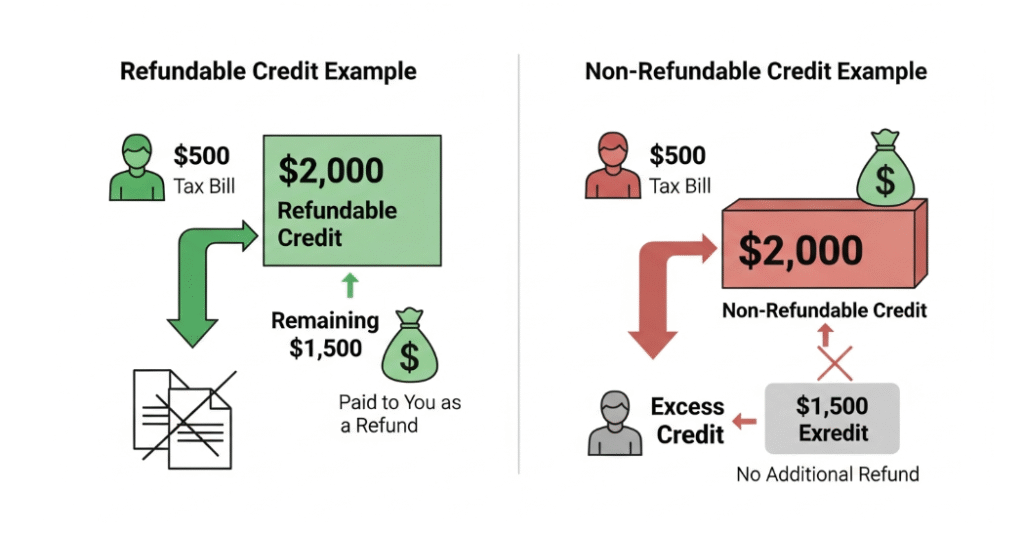
A refundable credit can pay you back even after your tax liability is zero, while a non-refundable credit’s value is capped at the amount of tax you owe.
To effectively manage your taxes, it is essential to grasp the distinct functions of refundable credits, non-refundable credits, and deductions. Each serves a different purpose in calculating your final tax bill or refund.
The Fundamental Concept of a Refundable Credit
The core concept of a refundable credit is simple: it is treated as a payment you have made to the government. Imagine you owe $500 in income tax and qualify for a $2,000 refundable credit. The credit first eliminates your $500 tax bill. The remaining $1,500 is then issued to you as a refund. This mechanism is what makes these credits so powerful.
Refundable Credits vs. Non-Refundable Credits: A Key Distinction
The primary difference lies in what happens to the excess credit amount. A non-refundable credit can reduce your tax liability only to zero. If you owe $500 in taxes and have a $2,000 non-refundable credit, it will wipe out your $500 bill, but you will not receive the remaining $1,500. A refundable credit, in the same scenario, would give you that $1,500 back. This distinction is critical for taxpayers with low tax liabilities who stand to benefit most from the refundable portion.
Refundable Credits vs. Tax Deductions: What You Need to Know
Tax deductions are fundamentally different from tax credits. Deductions reduce your taxable income, not your tax bill directly. For example, a $1,000 deduction for someone in the 22% tax bracket reduces their tax bill by $220 ($1,000 x 0.22). In contrast, a $1,000 tax credit reduces the tax bill by the full $1,000. Because credits provide a direct, dollar-for-dollar reduction, they are generally more valuable than deductions of the same amount.
How Refundable Credits Can Lead to a Tax Refund Even with No Income Tax Liability
This is the most significant feature of refundable credits. Many low-income individuals and families may not earn enough to owe federal income tax. Without refundable credits, they would receive no direct benefit from the tax system. However, by filing a tax return and claiming refundable credits, these people can receive a substantial refund from the government, providing essential financial support.
Essential Refundable Federal Tax Credits for Individuals
Several key refundable credits are available to eligible U.S. taxpayers. Understanding the purpose and requirements of each is the first step toward claiming them.
The Earned Income Tax Credit (EITC)
The EITC is a cornerstone tax benefit for low-to-moderate-income working individuals and families. Its purpose is to supplement the earnings of workers and reduce poverty. Eligibility depends on your income, filing status, and the number of qualifying children you have. Even workers without children may qualify for a smaller credit. To claim the EITC, you must have earned income and meet certain rules. The credit amount varies significantly based on family size and income level, potentially resulting in a substantial refund. Taxpayers often use Schedule EIC (Form 1040) to provide information about their qualifying children.
The Child Tax Credit (CTC) and Additional Child Tax Credit (ACTC)
The Child Tax Credit is designed to help families with the expenses of raising children. For the 2024 tax year, the credit is worth up to $2,000 per qualifying child. A significant portion of this credit is refundable through the Additional Child Tax Credit (ACTC). The refundable portion for 2024 is up to $1,700 per child. To qualify, the child must be under 17, be a U.S. citizen or resident alien, and meet other dependency requirements. The CTC and ACTC phase out as income rises, making them primarily beneficial for low-to-middle-income families.
The American Opportunity Tax Credit (AOTC)
The AOTC helps offset the costs of post-secondary education. It is available for the first four years of higher education for an eligible student. The credit is worth up to $2,500 per student per year, calculated as 100% of the first $2,000 in qualified education expenses and 25% of the next $2,000. Crucially, up to 40% of the credit (a maximum of $1,000) is refundable. This means even if you owe no taxes, you could receive a refund of up to $1,000. To claim the AOTC, you must complete Tax Form 8863, Education Credits.
The Premium Tax Credit (PTC)
The Premium Tax Credit helps eligible individuals and families afford health insurance purchased through the Health Insurance Marketplace. This credit is unique in that it can be paid in advance directly to your insurance company to lower your monthly premiums, or you can claim it all when you file your tax return. The PTC is fully refundable. When you file your taxes using Form 8962, you reconcile the amount of advance credit payments you received with the actual credit you qualify for based on your final yearly income. If you used less than you were eligible for, the difference is added to your refund.
Other Significant Refundable Federal Tax Credits
Beyond the major credits that benefit millions of Americans, several other refundable credits target specific situations.

The Fuel Tax Credit
This credit is primarily for individuals or businesses who use fuel for off-highway business purposes (like in farming or construction) or for other non-taxable uses. Because federal excise tax is included in the price of fuel at the pump, this credit allows eligible taxpayers to get a refund for the tax paid on fuel used for qualifying purposes. Taxpayers claim this credit on Form 4136, Credit for Federal Tax Paid on Fuels.
Credit for Prior Year Minimum Tax (AMT)
The Alternative Minimum Tax (AMT) is a parallel tax system designed to ensure that high-income individuals pay at least a minimum amount of tax. If you paid AMT in a prior year, you might be able to claim a credit against your regular tax in the current year. While much of this credit is non-refundable, a portion can be refundable for certain long-term unused minimum tax credits, though this applies to a very small number of taxpayers.
Credit for Excess Social Security Tax Withheld
If you worked for two or more employers during the tax year and your combined wages exceeded the annual Social Security wage base limit, you may have had too much Social Security tax withheld. This excess amount is treated as a refundable credit. You can claim the overpayment as a credit against your income tax when you file your Form 1040. This ensures you get back the extra amount that was withheld from your paychecks.
Maximizing Your Refundable Credits: Key Considerations and Best Practices
Knowing about these credits is only half the battle. To ensure you receive the full refund you are entitled to, you must be diligent in your tax preparation.
Understanding Modified Adjusted Gross Income (MAGI) for Each Credit
Eligibility for many refundable tax credits is determined by your Modified Adjusted Gross Income (MAGI). The calculation for MAGI can differ slightly for each credit, so it is vital to follow the specific instructions for the credit you are claiming. Tax software automatically handles these calculations, but if you file by paper, you must pay close attention to the definitions on the relevant Tax Forms.
Accurate Recordkeeping is Crucial
To claim any tax credit, you must have records to support your eligibility. This includes proof of income (W-2s, 1099s), documentation of education or healthcare expenses, and records for your children (birth certificates, school records). Keeping these documents organized throughout the year will make filing your tax return much easier and will be essential if the IRS sends a notice requesting verification.
Avoiding Common Mistakes
Simple errors can delay your refund or lead to your claim being denied. Common mistakes include math errors, incorrect Social Security numbers for dependents, and incorrect filing status. For credits like the EITC, errors related to qualifying child rules are frequent. Using tax software can help prevent many of these mistakes, and carefully double-checking your tax return before filing is always a good practice.
Navigating Changes in Life Circumstances
Life changes—such as getting married, having a child, changing jobs, or a dependent moving out—can significantly impact your eligibility for refundable credits. It is important to assess your situation each year to determine which credits you qualify for. A change in income or family structure could make you newly eligible for a credit you couldn’t claim before, or vice versa.
The Refund Process: What Happens After You File Your Taxes
Once you have submitted your tax return, the final step is receiving your refund. Understanding this process can help you manage expectations and track your money.

Filing Your Tax Return: Options for Claiming Credits
The most efficient way to file your tax return and claim credits is electronically. E-filing with direct deposit is the fastest way to get your refund. You can use commercial tax software, the IRS Free File program if your income is below a certain threshold, or hire a tax professional. Filing by mail is an option, but it results in significantly longer processing times.
Tracking Your Refund Status
After filing, you can track the status of your refund through the “Where’s My Refund?” tool on the official IRS website. You will need your Social Security number, filing status, and the exact amount of your expected refund. The tool provides updates on whether your return has been received, approved, and sent.
What Happens if There’s an Offset
In some cases, your refund may be reduced or “offset” to pay certain past-due debts. The Treasury Offset Program can apply your refund to overdue federal taxes, state income tax, child support, or federal non-tax debts like student loans. If an offset occurs, you will receive a notice from the government explaining the reduction and providing contact information for the agency that received the payment.
Conclusion: Empowering Yourself with Knowledge of Refundable Tax Credits
Understanding and claiming refundable federal tax credits is one of the most effective ways for American taxpayers to improve their financial standing. These credits are a deliberate government policy designed to provide direct relief and support to working individuals and families across the nation. By moving beyond simple tax deductions, they offer a powerful opportunity to receive a significant monetary refund, fundamentally changing the outcome of filing a tax return for millions.
Recap of Key Takeaways for US Taxpayers
- Credits are more valuable than deductions: They reduce your tax bill dollar-for-dollar.
- Refundable credits can result in a cash refund: Even if you owe no income tax, you can receive money back.
- Know the major credits: The EITC, CTC/ACTC, AOTC, and PTC are the most significant refundable credits for individuals.
- Accuracy is paramount: Ensure all information on your tax return, especially Social Security numbers and income figures, is correct to avoid delays or a government notice.
- Use available resources: The official IRS website and tax preparation software are invaluable tools for identifying and claiming every credit you deserve.
By taking the time to learn about these credits and carefully preparing your taxes, you empower yourself to claim the full refund you are rightfully owed. This knowledge is not just about compliance; it’s about leveraging the tax code to your advantage and securing your financial future.
Learn more about Personal Property Tax in Missouri.